 Cairn
Cairn
Board Kanban
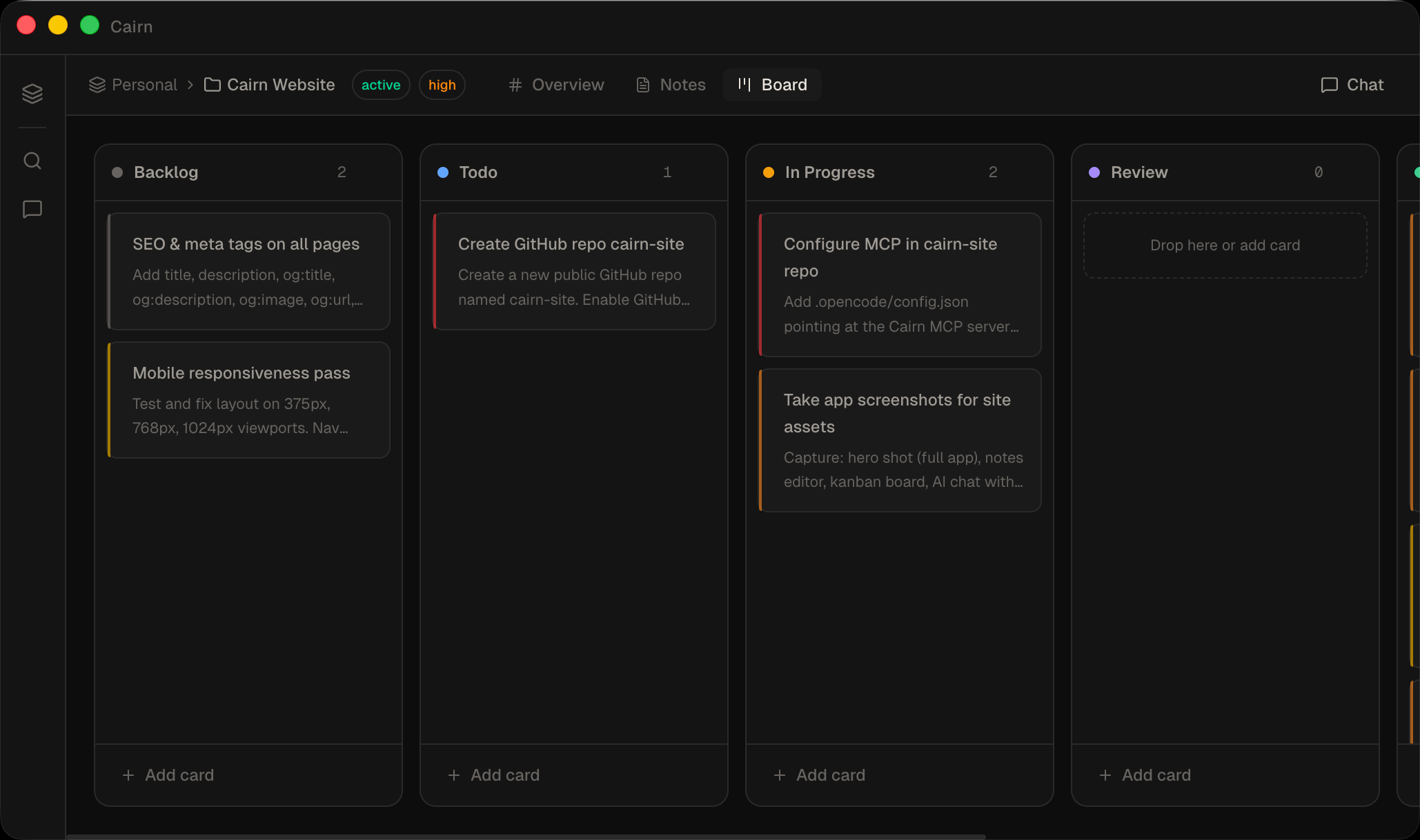
Every project has a Board tab — a drag-and-drop Kanban board with configurable columns, priorities, due dates, task dependencies, tags, and WIP limits. It's the same task data the AI chat, agent, calendar, and MCP tools work with, just laid out as cards.
Opening the board
Select a project and click Board in the top nav, or press ⌘3. New projects start with five default columns — Backlog, Todo, In Progress, Review, Done — created automatically.
Creating a task
- Click + Add card at the top of any column
- Enter a title. Optionally add a description (markdown), priority, due date, and tags.
- Press Enter or click outside to save
Cards show a lightweight text preview when collapsed and render full markdown when expanded, so switching to the Board stays fast even on boards with long descriptions.
Priorities
Each card has a priority — low, medium, high, or urgent — shown as a coloured stripe on the card and used to size dots in the Insights analytics canvases. Medium renders blue, consistently across the board, card detail, and charts.
Columns & WIP limits
- Add a column with the
+button at the right of the board - Rename by double-clicking the column header
- Reorder by dragging the grip handle
- Delete via the column's
⋯menu - WIP limits — set a maximum card count per column. When the limit is hit, the header badge turns amber and new cards can't be added through the UI (cards can still be dragged in).

Card detail
Click any card to open its detail view — as a modal, or in a panel beside the AI chat when the chat is open (both share one implementation, so they stay in sync). From the detail view you can:
- Edit the title and markdown description
- Set priority, due date, and assignee
- Add or remove tags
- Link notes to the card (bidirectional — the note knows its card, the card knows its note)
- Add or clear task dependencies
- Spawn Agent — kick off the built-in coding agent (or an external CLI agent) with the card's title and description pre-filled as the prompt
Task dependencies
A card can be marked as blocked by another card in the same project. A blocked card is visually flagged, and a blocker counts as resolved as soon as it moves to a done column or is archived. Circular dependencies are rejected automatically. Dependencies can be set from the card detail, from the AI chat, or via the MCP update_task tool (blockedBy / unblockFrom).
Ask the assistant for unblocked, active work and it uses list_ready_tasks — only cards with no pending blockers that aren't already in a done column. Great for "what can I start right now?"
Moving & filtering
- Drag between columns — collision detection resolves the drop target from your actual pointer position, so drops land where you aim across any window size or scroll position, and drags stay smooth on busy boards.
- Reorder within a column — drag a card up or down.
- Move to another project — drag a card onto a project row in the leftmost sidebar. It lands in the target project's column of the same type (In Progress → In Progress), falling back to Backlog if there's no match, so its state is preserved.
- Filter toolbar — a persistent toolbar above the board has priority chips (Urgent / High / Medium / Low) — tap one or more to show only those priorities (toggle off to clear) — plus a search box that filters cards by title or description as you type. Filters combine, a match count shows in the toolbar, and a clear button resets everything. ⌘F still focuses the search.
- Context menu — right-click any card to archive or delete it without opening the detail view.
Every move is undoable with ⌘Z / ⌘⇧Z.
Archive
Right-click a card and choose Archive to collapse it into a hidden section at the bottom of its column. Expand the section to review archived cards and restore any of them back to active. Archiving keeps a completed board tidy without deleting history; archived cards are excluded from the Calendar's overdue tracking and the "ready"/"due" task lists.
The board and the AI
The board isn't a separate silo — the AI chat, coding agent, and any MCP client read and write the same cards. The assistant can create cards, move them between columns, set priorities and due dates, add tags, link notes, and manage dependencies. See AI Chat and the MCP Server tool reference for the full set of task tools.